About FOODTURE: Sustainable Food Systems Research
FOODTURE at glance

January 2025 – December 2028

20 partners

5 use cases

8 European countries
1 South American country
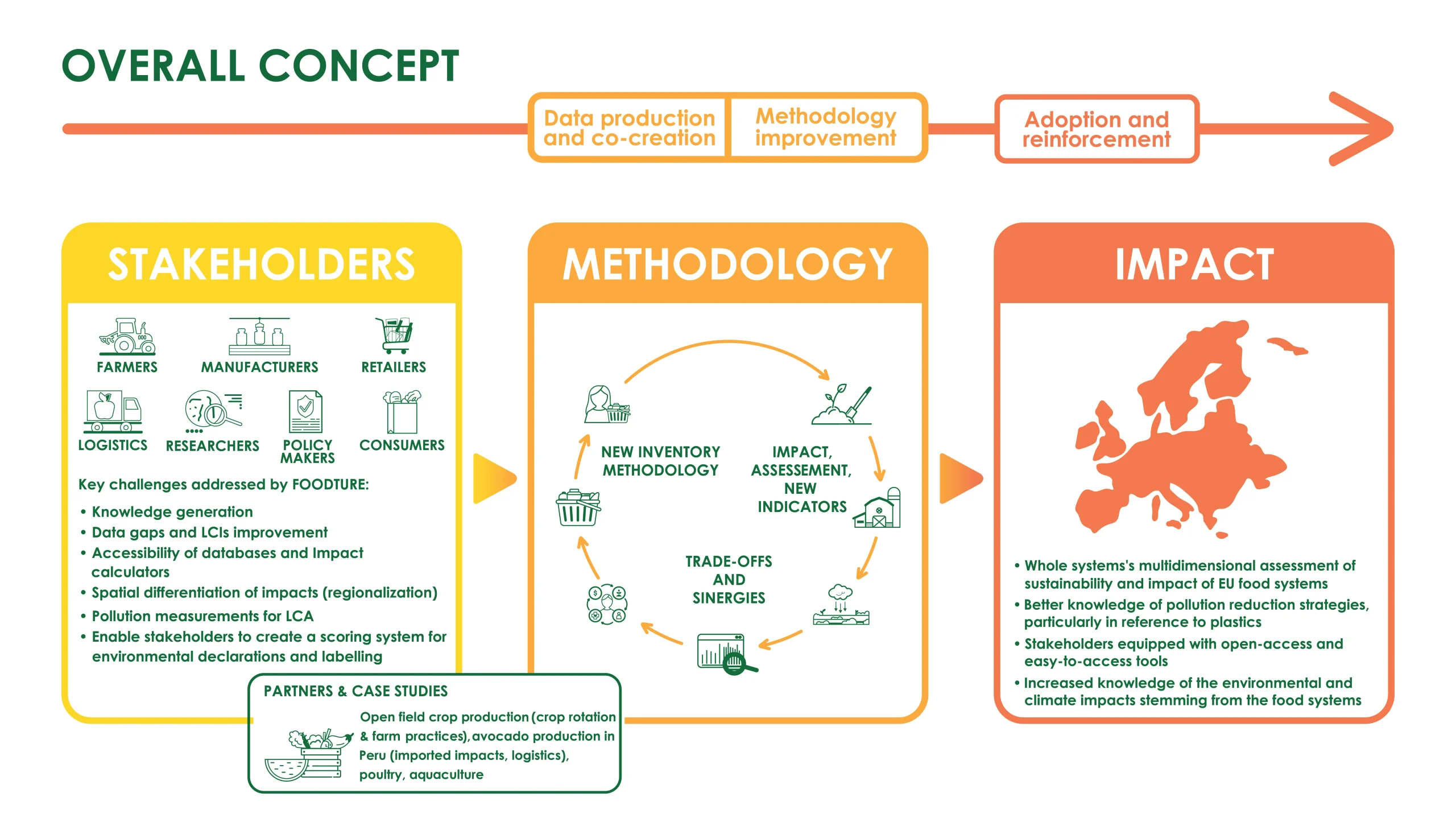
Concept
FOODTURE starts from a simple idea: you can’t improve what you can’t measure. As Europe works to create healthier, more resilient food systems, FOODTURE provides the data, tools, and partnerships to make it happen.
The project develops the next generation of Life Cycle Assessment (LCA) methodologies to track food’s full impact, from how it’s grown to how it’s eaten. Using precision agriculture, remote sensing, and spatial data, the project builds detailed Life Cycle Inventories (LCIs) and analyzes the trade-offs and synergies between environmental, economic, social, animal welfare, and health impacts.
Everything we produce is open-access, so any actor in the food system can apply it in practice. The output is a clear, science-based path towards a food system that is more circular, more transparent, and lower-pollution — built for Europe’s future.
Objectives
FOODTURE aims to change how the European food sector measures its own impact by improving the accuracy of impact assessments the sector relies on. The project develops and validates enhanced Life Cycle Assessment (LCA) methodologies that go beyond the generic data currently in use, producing results specific to real products, regions and practices.
Stakeholders take part at every stage, which helps the project identify practical ways to reduce environmental pressures and make food value chains more resilient.
Openness and transparency are built in, so the results can be used and built on well beyond the project itself.
A specific focus is validating precision agriculture techniques and environmental management practices that reduce pollution and improve data quality. In short, FOODTURE is working to raise the standards for evidence-based decision-making in European food systems.

Advanced Life Cycle Assessment methodologies
Develop and validate improved LCA and LCIA methods that capture the full spectrum of food system impacts, including environmental, nutritional, social, and economic dimensions.

Create Europe-wide food system inventories
Build harmonized Life Cycle Inventories (LCIs) that map production, processing, packaging, and distribution activities across the EU.

Enable holistic system-level impact assessment
Quantify trade-offs and synergies between sustainability goals, including climate, biodiversity, animal welfare, public health, and economic performance.

Support decision-making with open tools and policy integration
Provide open-access tools, datasets, and policy briefs that translate complex research into practical recommendations for stakeholders and policymakers.

Foster multi-actor engagement across the food value chain
Engage farmers, companies, public bodies, scientists, and consumers through workshops, co-creation, and capacity-building activities to ensure the broad uptake of project results.

Communicate and disseminate for impact
Drive visibility, understanding, and adoption of project outcomes through coordinated communication strategies, scientific dissemination, stakeholder outreach, and public engagement.
Key perfomance indicators

80% of the European food market covered by 8.000 datasets

1 land use intensity map

1 Environmental impact calculator tool

5 policy briefs

30 workshops with relevant stakeholders
