
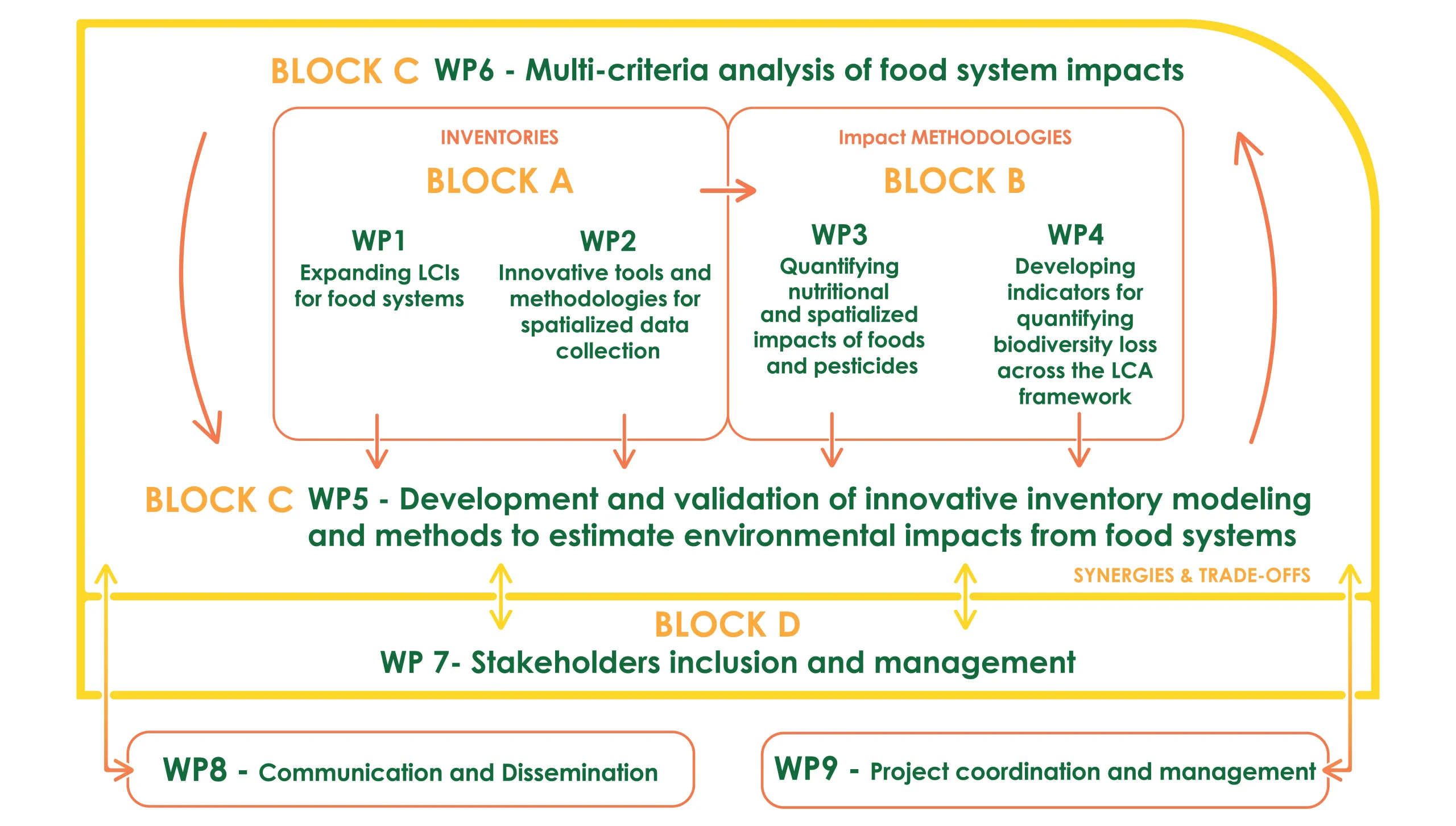
This work package will build around 8,000 life-cycle inventory (LCI) datasets across European countries, covering at least 80% of the food products consumed. The FOODTURE team is developing a robust framework for a comprehensive food-product database that captures every stage of the chain, from field to shelf. Value-chain stakeholders are consulted throughout, so the database reflects real practice. It will align with European policy and the Product Environmental Footprint (PEF) method, and document both mainstream production and the greener alternatives that show the biggest room for improvement.
Main results:
- A harmonized Life Cycle Inventory
- Comprehensive data on EU food systems
- FOODTURE version of Means InOut software for eco-design
Led by: The French Agency for Ecological Transition

This work package explores new technologies for improving how impacts are characterised inside the Life Cycle Assessment (LCA) framework, and how the resulting data can plug into existing methods. High-resolution satellites make it possible to build field-specific inventories for land use, land-use intensity and erosion risk. Beyond satellites, the team combines satellite and UAV data to better read biodiversity in agricultural landscapes, and tests sniffer sensors mounted on drones to measure gas emissions and air pollution from farms. Everything developed here is designed to slot back into existing LCA frameworks.
Main results:
- Land use intensity datasets
- Erosion risk map
Led by: University of Gent

This work package improves the Life Cycle Impact Assessment (LCIA) methods used for food production and consumption. The focus is on human health — where nutrition itself is one of the largest factors — and on the impacts of pesticides, including residues, when comparing organic and conventional produce. The team is also improving how the geography of pesticide impacts is measured for freshwater ecosystems, and adding terrestrial ecotoxicity, which today is missing from LCIA. All indicators are developed at both midpoint and endpoint level and made compatible in terms of time horizons and reference states, so they can be used together when selecting healthier, more sustainable food baskets.
Main results:
- Comprehensive assessment of how different food baskets impact human health
- Detailed quantification of human health impacts from pesticides and overall food production
- Enhanced methodology to evaluate pesticide impacts on freshwater and terrestrial ecosystems
Led by: Technical University of Denmark

This work package improves how Life Cycle Impact Assessment measures biodiversity. The team focuses specifically on biodiversity loss from pollution and land use — through water, air and soil pathways.
Main results:
- Aggregation of biodiversity impacts
- Assessment framework for evaluating the impacts of food production on biodiversity
Led by: Norwegian University of Science and Technology

This work package develops a robust method for estimating the environmental impact of food products, then tests it. Together with what comes out of the other WPs, the method is validated through case studies in four sectors: crop production (domestic and imported), poultry, aquaculture and complex multi-ingredient products, covering different production systems (conventional, organic, and so on). The case studies identify the hotspots where impact concentrates and the opportunities for improvement, feeding into recommendations for reducing pollution across the food value chain.
Main results:
- Indicator mapping system for environmental impact assessment
- Enhanced Product Environmental Footprint (PEF+) methodology for food systems analysis
- Quantitative assessment of environmental impacts from various food baskets and dietary patterns
- Case studies demonstrating methodology application across key food sectors
Led by: Beta Tech Center

This work package looks at the food system as a whole. It maps European food systems from a life-cycle perspective and adapts the food-system model so it can work at multiple levels at once — from single supply chains up to national diets. It integrates the improved LCIs and impact-assessment methods from earlier WPs, defines food baskets for specific regions, and uses the model to see where different goals — environmental, economic, social, animal welfare, health — pull in the same direction, and where they trade off.
Main results:
- System analysis framework with identified trade-offs across environmental and socioeconomic dimensions
- Detailed characterization of European regional food baskets and their varying environmental footprints
- Predictive modeling tool evaluating the impact potential of innovative food system solutions
- Multi-criteria assessment methodology that holistically captures diverse food system impacts
Led by: The Research Institute of Organic Agriculture

This work package turns the project's research into something people can actually use, through direct engagement with policy and other stakeholders. It follows the EU's principles of transparency and open access, and covers the practical work of finding out what stakeholders need, running participatory workshops, writing policy recommendations, and producing short, plain-language materials for end users.
Main results:
- Assessment of stakeholders needs to guide the uptake of project outcomes and inform policy development
- A series of co-creation and validation workshops bringing together key actors from across the food value chain
- Policy briefs and recommendations supporting inclusive and evidence-based policy frameworks for food systems
- Practice abstracts developed in line with the EIP-AGRI format, offering practical insights for end users and practitioners
- Enhanced awareness among European institutions and networks regarding the role of participatory policy development in sustainable food system transformation
Led by: General Confederation of Italian Agriculture

This work package makes sure FOODTURE's results get out, get used, and keep being useful after the project ends. Following a structured communication, dissemination and exploitation plan (the PDEC), it combines digital and in-person channels with content tailored to each audience, and runs a Learning Academy to build capacity and share what the project has learned with related initiatives.
Main results:
- Strategic plan for communication, dissemination, and exploitation
- Environmental impact calculator to support awareness and understanding among non-expert audiences
- A long-term sustainability and exploitation roadmap to ensure the continued use of FOODTURE’s tools and results beyond the project’s duration
- Broad visibility of the project across digital platforms, events, and partner networks, reaching key actors across the food system
- A collaborative learning academy for capacity building, knowledge sharing, and integration of FOODTURE outputs into real-world contexts
Led by: The Association of Balkan Eco-Innovation

This work package keeps the whole project running: coordination, administration and quality assurance across every partner. It covers financial and administrative management, risk, ethics and data governance, and makes sure FOODTURE stays on track against the Grant Agreement and Horizon Europe requirements.
Main results:
- Quality management plan that defines internal procedures, responsibilities, and monitoring systems to ensure smooth project execution
- An ethics plan outlining measures for safeguarding compliance with ethical standards and regulatory requirements across all research activities
- A data management plan detailing how project data will be collected, stored, shared, and preserved in accordance with FAIR principles and Horizon Europe guidelines
Led by: Beta Tech Center